

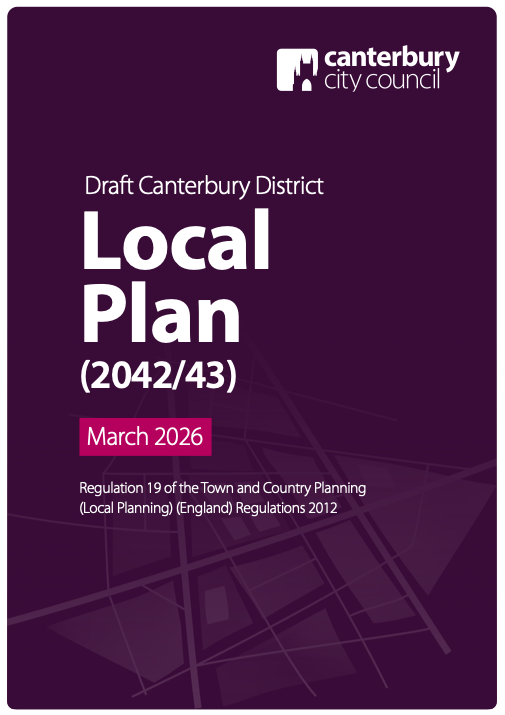
Canterbury City Council has published the final draft of the district’s Local Plan, setting out how housing, infrastructure and environmental policy could shape Canterbury, Herne Bay and Whitstable through to 2043.
The plan proposes delivery of 1,215 homes per year, alongside requirements for affordable housing, increased brownfield development, biodiversity net gain and strengthened infrastructure policy. Several previously proposed allocations have been removed, including land at Rattington Street (Chartham) and east of Chestfield.
If approved by councillors in March, the plan will move to Regulation 19 consultation, the final formal stage before submission to a Planning Inspector for Examination in Public.
What Regulation 19 Means
Regulation 19 is not a general “have your say” consultation. It is the formal publication of the Council’s intended submission version of the Local Plan — in effect, the draft it plans to send to a Planning Inspector.
At this stage, representations must focus on whether the plan is legally compliant and “sound”. Soundness is defined in national planning policy. The Inspector will examine whether the plan has been positively prepared, whether it is justified by proportionate evidence, whether it is deliverable over the plan period, and whether it is consistent with national policy.
All representations submitted at Regulation 19 are passed directly to the Inspector alongside the plan and its supporting evidence. Although the Inspector can recommend Main Modifications later (which would themselves be subject to consultation) Regulation 19 is the final opportunity to make structured, policy-based representations before the plan is formally submitted.
Key Issues for Canterbury
A Local Plan shapes development decisions for at least fifteen years. Without an adopted plan, development does not pause; instead, decision-making becomes more reactive and harder to manage strategically.
The Canterbury Society will review the draft carefully. Particular attention will be given to infrastructure timing and phasing, water and sewerage capacity, delivery realism, and the protection of heritage within a World Heritage setting. We will also examine how the plan aligns with the recently adopted City and Town Centre Strategies and whether its environmental and biodiversity standards are robust in practice.
One of the central questions will be sequencing: whether infrastructure genuinely keeps pace with housing delivery, rather than following behind it.
The Society previously submitted detailed representations at the Regulation 18 (Focused) stage, covering housing distribution, infrastructure capacity, heritage impact, environmental safeguards and settlement-level service pressures. That submission remains available and provides important context for our ongoing review of the submission draft:
👉 Read the Canterbury Society Regulation 18 submission
What Happens Next
The draft will be debated by councillors in March. If approved, an eight-week Regulation 19 consultation will follow before the plan is submitted to the Secretary of State and examined independently later this year.
We will publish further guidance for members when the consultation opens, including how to frame effective representations.
Local Plans may be technical documents, but their consequences are very real.
They determine where growth takes place, how infrastructure is delivered, and how heritage and landscape are safeguarded for the long term.
👉 Read Canterbury City Council’s full press release