
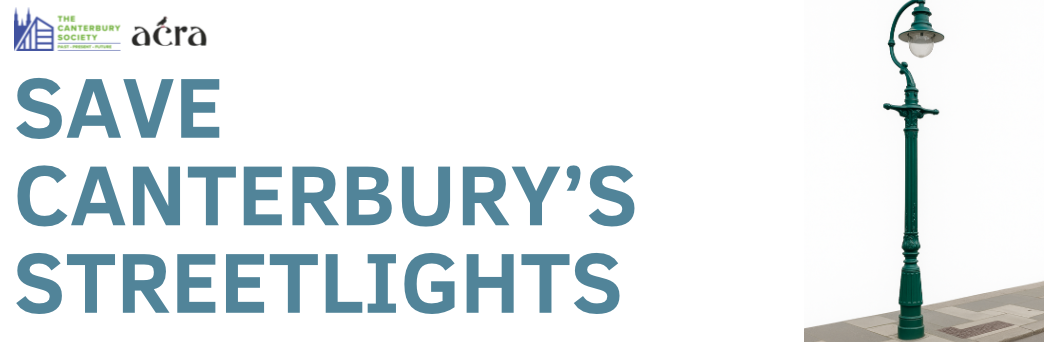
Why Canterbury’s historic streetlights are being lost
Canterbury’s distinctive cast-iron streetlights – many still stamped with the old Canterbury City Corporation crest – are under threat. Kent County Council (KCC) is condemning these historic columns and intends to replace them with generic steel poles fitted with standardised “heritage-style” embellishments.
These streetlights are not being lost because of a single bad decision, a sudden safety issue, or a lack of money. They are being lost, in part, because Canterbury City Council does not have a clear, adopted streetscape or public realm policy for its historic areas.
In the absence of that framework, decisions about the city’s everyday fabric – street lighting, paving, materials and detailing – are being taken piecemeal, scheme by scheme, often by default rather than by design. That is the nub of the issue.
Residents and heritage groups, including the Canterbury Society, the Alliance of Canterbury Residents Associations (ACRA) and the Oaten Hill and South Canterbury Association (OHSCA), are calling on Canterbury City Council to put clear controls and guidance in place, including the use of an emergency Article 4 Direction where appropriate, to protect these features before they are lost.

These elegant cast-iron columns are a unique part of Canterbury’s civic and industrial heritage. They were produced by H.M. Biggleston & Sons, a Canterbury ironworks founded in 1835 and located in the heart of the city. The firm supplied lamp posts to the City for nearly 130 years and, from 1908, became a leading manufacturer of electric street lighting equipment, supplying fittings across Britain and overseas. The foundry finally closed in 1963, but replica Biggleston-style columns continued to be installed and repaired in Canterbury well into the 21st century – with examples recorded as recently as 2023.
“These lamp columns are as much a part of Canterbury’s story as its walls or gates, — they are a tangible links to a Canterbury firm whose craftsmanship literally helped light cities across the world.
To replace them with mass-produced steel poles is cultural vandalism.”
As a World Heritage City, Canterbury has a statutory duty to protect not just landmark buildings, but the wider streetscape that forms their setting. While KCC carries out highway works under its statutory powers, Canterbury City Council is responsible for planning, conservation and setting the standards that guide what replacement should look like in historic areas.
Under planning law, CCC can issue an emergency Article 4 Direction to withdraw permitted development rights for the replacement or alteration of street lighting within the city’s Conservation Areas. This would bring such works under planning control and require formal permission for any future replacements – ensuring consistency and heritage-appropriate design.
“Kent County Council maintains street lighting and replaces columns when they fail….
…where Canterbury City Council has not set clear streetscape standards for conservation areas, replacements default to generic solutions under permitted development, rather than being guided by a coherent local framework.”
Residents can already see the consequences. In some locations, particularly within City Council-led £20m Levelling Up Fund projects, cast-iron columns are being repainted or replicated as valued heritage assets. In nearby streets, identical columns are being removed or replaced, while temporary steel columns installed years ago remain unresolved. Design quality varies from street to street, with no clear rationale. This is exactly what happens when there is no agreed framework to guide decisions.
The campaign is not calling for blanket retention or unlimited spending. It is asking Canterbury City Council, as Local Planning Authority, to do what only it can do: put in place clear streetscape and public realm guidance for historic areas, treat heritage street furniture as an asset rather than an inconvenience, and ensure that like-for-like repair or genuinely appropriate replica replacement becomes the default. Decisions should be consistent, transparent and deliberate, not ad-hoc.
An emergency Article 4 Direction is one possible tool, but it is not the core issue. Until the policy gap is filled, the same piecemeal losses will continue, not just to streetlights but to paving, lighting character and other elements of the public realm.
A petition calling on Canterbury City Council to act has been launched by the Canterbury Society and will be formally presented to Cllr Alan Baldock, Leader of the Council.
Heritage Streetlights – Your Questions Answered
What’s happening to Canterbury’s cast-iron streetlights?
Kent County Council (KCC) has started removing some of Canterbury’s historic cast-iron “Biggleston” columns and replacing them with modern steel ones. This has happened because many cast-iron columns are ageing, and KCC has safety obligations as the Highways Authority.
Why are residents concerned?
| The original columns are a distinctive part of Canterbury’s character, especially in Conservation Areas. The steel replacements are generic and out of keeping with the historic streetscape. People want reassurance that any replacements will respect the city’s heritage. |  |
Who is responsible for what?
Kent County Council (KCC) owns and maintains street lighting on the public highway and is responsible for safety.
Canterbury City Council (CCC) is the Local Planning Authority responsible for Heritage and Conservation policy.
KCC carries out the physical works.
CCC sets the rules, standards and expectations for how those works should look in Conservation Areas and the World Heritage setting.
In short: KCC does the work; CCC can control the design quality in historic areas.
Why hasn’t this been sorted out already?
Correspondence released under the Environmental Information Regulations (covering 2020-2025) shows that:
– KCC repeatedly asked CCC for conservation guidance, design approval and a clear position.
– CCC did not provide a settled written response or agreed standard.
– No Canterbury-specific Heritage streetscape specification or design framework was submitted by CCC.
– Decisions stalled, leaving KCC to act under its safety duties using what was legally permitted.
Only when a whole street of historic lampposts were proposed for removal did the scale and long-term impact of generic replacements become clear.
The approach being adopted by KCC (without access to CCC’s moulds to recreate the design) will result in these streetlights disappearing one-by-one, whether through damage or age-related wear.
Why can’t CCC just refuse the steel replacements?
CCC cannot just say “no”, but it can set the framework within which replacements happen.
Amongst others, it has the power to:
– issue an Article 4 Direction to remove automatic permitted-development rights in Conservation Areas;
– an Article 4 is the only legal route to require like-for-like repair or replica replacement, including use of Biggleston-style castings;
– introduce a streetscape policy setting clear standards for lighting, materials and reinstatement to protect more than just streetlights, but the public realm in our conservation areas.
These tools exist but have not yet been put in place.
What are the broader implications?
Without a clear streetscape or public-realm policy, decisions default to what is legally permitted rather than what is appropriate for a World Heritage city.
This does not just affect streetlights. The same gap in guidance influences:
– paving materials and finishes
– lighting colour and intensity
– street furniture and signage
– utility reinstatement and “temporary” works that become permanent
When there is no agreed framework, decisions are taken piecemeal, scheme by scheme, often by default rather than by design. That leads to inconsistency, wasted public money, and the gradual erosion of Canterbury’s distinctive character.
Street lighting has simply made the problem visible. Without action, the same pattern will continue across the city’s public realm.
What about the Biggleston cast-iron moulds?
Canterbury City Council has already commissioned new Biggleston-style moulds as part of its Levelling Up Fund public-realm works for the Biggleston lights it maintains along the City Wall and in the Dane John Gardens.
This will mean accurate replicas can be made when refurbishment is not possible.
KCC appear to be unaware of this mould being taken, quoting the cost of creating one as a barrier to like-for-like replacement.
Has the steel design been approved by CCC?
No.
The steel columns and generic “heritage-style” kits currently being installed have not been formally approved by CCC’s conservation or planning teams.
KCC appear to have proceeded because it could not obtain a clear decision and had to meet safety obligations.
It appears to be the consequence of a lack of joined-up working and absence of policy, not a jointly agreed design.
Are the original columns unsafe?
A small number of poorly maintained columns may require additional work. The safety of individual columns should be assessed properly, but most can be restored.
Replacement should only happen where genuinely required – and where it does, like-for-like heritage reinstatement should be the standard.
Is there a map of these?
We are building a public map showing every cast-iron column across the district, using KCC’s own street-lighting inventory data. You can explore it below (or here):
The map lets you:
- see exactly where the heritage columns are located
- understand which streets and neighbourhoods are affected
- zoom in street-by-street
- and check how many columns remain in each area.
It is the first time this information has been available to the public in a single, accessible format.
my father worked at Biggleston foundry. Seeing those lamp posts disappear one by one breaks my heart. They’re part of our city’s story made here, for here you can’t just replace that with a bit of steel tubing from a Freemans catalogue.
I walk past these every day on the school run they’re part of what makes Canterbury feel like Canterbury.
It’s honestly wild that they’re replacing perfectly good posts instead of just repainting them.
We talk about sustainability all the time, and this is literally the opposite!! throwing away something that’s lasted a century for new steel that’ll need replacing again in 20 years. Heritage is sustainability.
These should be listed in order to protect them
The original lamppost in Castle Street by the junction with St John’s Lane was knocked down by a lorry some years ago and attempts to get the Council to replace it with the same kind have failed. They have placed a straight steel lamppost next to the bandaged stump of the old one which remains where it was. The local residents association have not replied to my recent messages to get them involved in this issue.
I’ve gladly signed the petition, as a lover of Canterbury and its rich heritage. Such treasures must be defended against ignorant vandals and cheapskates.
I, and my darling late wife, Charlotte, visited the beautiful city of Canterbury some years ago and to learn, via the BBC’s Radio 4 Today programme, that these beautiful and iconic streetlights are to be replaced by characterless modern alternatives, is a shortsighted act of negligence by Kent County Council (KCC). I sincerely hope that the petition will send a clear message to KCC that some things are worth saving and preserving.
“Big Yellow Taxi” was a song originally written and sung by the Canadian singer-songwriter Joni Mitchell, the main chorus lines from which are:
Don’t it always seem to go
That you don’t know what you got ’til it’s gone?
They paved paradise and put up a parking lot
I think this would be a fitting sentiment to add to the arguments being put to the council.
Can alamp post be listed? Yes , please!!
Like the cast iron lamp posts on the Chelsea Embankment the cast iron lamp posts of Canterbury are iconic. Part of the City’s rich heritage and history they must where they are in good condition be retained and not replaced by cheap to maintain modern posts. As it is they enhance the ambiance of the city especially when one wanders into the centre at dusk on a murky afternoon.
The council seem to want to remove all heritage character from Canterbury. Lamp post, old paving, signage, front of shops.
This is totally unacceptable – why would any sane person do this? The streetlights are some of thew oldest examples in the world. Last year i did some design work for the Foundry brewpub and one of the premium bottles of Whisky features one of the street lights on the front.
I would like to remind KCC that “Cast Iron does not rust, rot or erode” even underground.
Perhaps the very intelligent of those at KCC will go back to school