

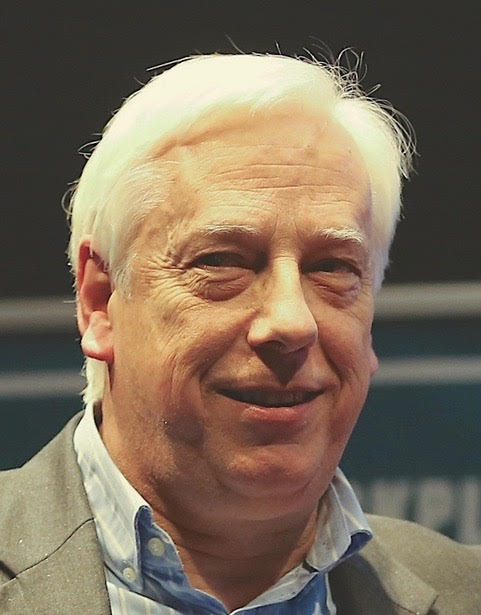
Dave Wilson was unanimously elected by the Committee in February 2026 as the new Chair of the Canterbury Society. A long-time member, he is one of our Trustees. We asked him about his background and his plans for the society’s future.
You've lived in Canterbury since 2012. Do you have earlier links to Kent?
Although I was born in Gloucester, I grew up in Kent from 6 months until 7 years old, living in Bexley (which of course in those long ago days was in Kent!) and then Bearsted.
What are the most important lessons you have learned from your extensive local government experience in such diverse authorities as Aberdeen, Hull, and London's Haringey?
Firstly, that to deliver their promises and achieve their aims, councillors need to be robustly assertive with officers. There is a healthy tension in local government between councillors, representing their constituents and their political views, and the professionals trying to deliver outcomes to align with that. Where either group is weak, or the other too strong, the result is ineffective delivery. Councillors therefore have to develop the skills to make intelligent challenges to officers, and to know when to press their case and when to accede to expertise.
Secondly, that no options are ever binary. Boundaries exist to be pushed and preconceptions to be confronted. When officers try to constrain debate or councillors’ right to express their views, that has to be challenged because it is anti-democratic.
In Canterbury you were a City Council member from 2019 to 2023. Do you feel you were able to accomplish what you wanted to in that role?
Well, I’m glad I was able to provide support to many residents in helping with problems. We (Labour) were in opposition at the time, so achievements at Council were precious, but I think we exposed the deficiencies in the Local Plan and at least kept the Conservative administration on its toes. Collectively I think that our Group laid the ground for Labour’s upsurge in vote in 2023, which lead to the current coalition. I wish that subsequently we had been better at delivering on the manifesto pledges, but of course running a Council in coalition requires compromise – and it’s certainly true that financial constraints are worse than we hoped.
You have also been a board member of several local organisations. Has there been a common theme to them?
Bizarrely, I don’t think there has been, other than my trying to apply my management experience to diverse situations in support of social improvement. You’d be hard pressed, I think, to find much commonality between Citizens Advice, Kent Savers Credit Union and the Westgate Hall Trust!
Currently you are a director of a charity creating homes for the clients of Porchlight to support its “Housing First” programme. Could you outline this project for us?
We’re at the very early stages on this one. Essentially, we’re trying to fund and convert flats for Porchlight to lease to their clients, and we’ve just completed the first one. We have access to some start-up capital to allow us to buy and convert a couple of properties, while capital funds are more difficult for Porchlight to raise and administer. As we have the property management and architectural expertise to find and improve the homes while Porchlight are leaders in helping the homeless, the partnership makes sense. The main challenge for us is raising more capital through grants or loans. We’re working on some exciting new options for charitable lending, where donors lend us money for 10 years and then get the capital sum back, so that they’ve sacrificed the interest rather than gifting the whole sum.
As well as your roles as a Councillor and with charities, how does your working career inform your role with the Canterbury Society?
I have had a varied career, including some formative experiences as a bus conductor, bar person and ice-cream van driver! But the bulk of my work was in hospitality in places around England and Scotland, and then in facilities management, which took me around the world.
I think the discipline you learn through working at a senior level in business is about focussing a vision, recognising the importance of delivery, and the vital need for a strategy to underpin both. Clarity of communications is also key to success. But I hope I also learned the downsides of overly aggressive corporate cultures. I was lucky enough to work on developing a number of International Standards and qualifications, where consensus building and compromise were more important than winning. In all that, exposure to other cultures was a valuable part of the experience and helped me see how much more people around the world have in common than what divides them.
As a campaigner on local issues you have written a great deal on local government reform and reorganisation, and recently gave a Canterbury Society lecture on the topic. What shape of government would you like to see for Canterbury, and for Kent as a whole?
When I travel I always look enviously at the public spaces and services in places such as France, Spain, Germany and the Nordics. These countries’ systems seem to deliver much better quality of life for residents without significantly higher taxes. And it seems to me, perhaps superficially, that they can do that because more funding and decision making is genuinely devolved to local government. They also have a system of regions (under various guises) which again replace much of central government in terms of strategic planning. It seems to me that’s a combination that works and which we might look at for England. In Canterbury, I believe it’s vital to create a Town Council as part of the forthcoming unitary local government, otherwise we risk losing the city’s voice.
What role do you think the Canterbury Society should play in these and other matters of local interest? What are your priorities as chairman?
We’re in large part an advocacy body, as well as being part of the network of civic organisations that exist in the city and district. I’ve been a member of the Society for a long time but only recently joined the committee, and I’m hugely impressed by the breadth and depth of expertise we are able to call on.
We’re certainly active in two currently high profile issues, around the Local Plan, which we believe is seriously flawed, and the impact of Local Government reorganisation, which we believe requires the establishment of town councils for the city and the coastal towns.
But – perhaps rather more quietly – our members work across a range of areas like planning, architecture, historic buildings, arts and culture, the environment and public health. I think, and hope, that we play a helpful role in understanding and coordinating all the work and initiatives that the Council and the many other specialist voluntary groups across the city are doing.
Regarding my own priorities: I simply want the Society to thrive and be recognised. To do that we have to focus on delivering and contributing in a positive way to each and every issue that affects our city.
Of course, as a volunteer body we can’t do everything, but if we carefully prioritise our efforts and keep all the challenges under review, I think we have access to such wells of expertise that we can help with almost anything. At least I hope that’s the case!
You have been, and continue to be, very active in community life. If you have any spare time, how do you like to spend it?
My wife makes me go on long walks to keep fit. We travel quite a lot as well, often to see historic buildings and gardens in the UK and Europe. We’re both interested in the arts, especially theatre and cinema, and I have quite a large music collection to try to keep in order (and even listen to occasionally). I watch quite a lot of football when I get the chance. And I cook, which takes my mind off everything else.
Already have an account? Log in to comment instantly, or comment as a guest below (subject to moderation).